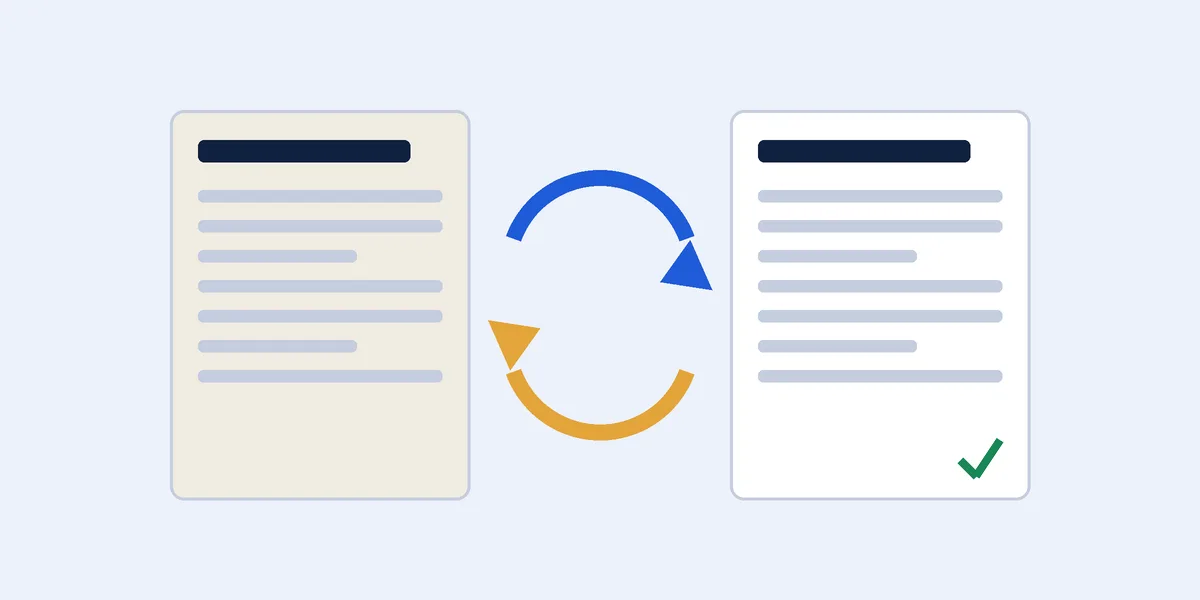
Article rewriting has two very different meanings in SEO. One is taking an article from another website and changing the words — by hand, with synonyms or with a “spinning” tool — so that it looks new. Google’s spam policies name this directly: republishing content from other sites after slight modification, including synonym substitution or automated techniques, is scraped content. The other meaning is refreshing your own pages so they are more accurate, complete and useful than when you first wrote them. That second kind of article rewriting is one of the best-value tasks in SEO.
When Article Rewriting Helps
- The facts have changed. Laws, fees, procedures, prices and dates go out of date. A page that is wrong loses trust and rankings together.
- The page answers less than the competition. If the pages above you cover questions yours does not, add them.
- Two of your pages compete. Merge them into one stronger page and permanently redirect the weaker URL.
- The page targets the wrong intent. A guide where searchers want a service page — or the reverse — needs restructuring, not polishing.
- The page is thin. A 300-word page in a field where the ranking pages are thorough guides will not climb on small edits.
When Article Rewriting Hurts
- Rewriting a competitor’s article, however thoroughly, adds nothing new. Google calls this scraped content.
- Spinning tools that swap synonyms produce text that reads badly and is easy for Google to detect.
- Producing many near-identical pages — city pages with only the place name changed, for example — is scaled content abuse under the March 2024 policies, whether a person or a program wrote them.
- Changing the date without changing the content misleads readers and does not fool Google.
A Content Refresh Method That Works
- In Search Console, list pages with impressions but a low click-through rate, or positions between 8 and 30.
- For each, read the top three results for its main phrase and note what they cover that your page does not.
- Check every fact on your page against a current source.
- Rewrite the sections that need it, add the missing answers, and update the title and description if they no longer match the search.
- Add or correct internal links to and from related pages.
- Update the “last updated” date only when the content really changed, and note what changed if it matters to the reader.
- Watch the page in Search Console for four to eight weeks.
Article Rewriting at Scale
Sites with dozens of old posts usually need triage before article rewriting. Pages fall into three groups: worth refreshing, worth merging into another page, and worth retiring with a redirect. Our SEO audit sorts them, and our writers carry out the refresh.
Frequently Asked Questions
Is article rewriting the same as paraphrasing?
Paraphrasing someone else’s article is still their work. Article rewriting in the useful sense means improving your own pages with new information, structure and accuracy.
Can AI rewrite my old articles?
AI can help draft, but someone who knows the subject must check every fact and add what is new. Google’s guidance is about the result, not the tool: helpful content is rewarded, mass-produced content made to manipulate rankings is not.
How often should content be refreshed?
When something in it changes, and at least once a year for pages about laws, prices or procedures.
Related Pages
Sources
Reviewed by: Mohsin Ali Shah, founder of SEO Content Master
Published by: SEO Content Master, seocontentmaster.com
Last updated: 29 October 2026